Home > Press > Nano-sized Electronic Circuit Promises Bright View of Early Universe
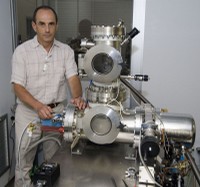 |
| Credit: Carl Blesch Physics Prof. Michael Gershenson with laboratory equipment used to fabricate ultra-sensitive, nano-sized infrared light detector. |
Abstract:
A newly developed nano-sized electronic device is an important step toward helping astronomers see invisible light dating from the creation of the universe. This invisible light makes up 98% of the light emitted since the "big bang," and may provide insights into the earliest stages of star and galaxy formation almost 14 billion years ago.
Nano-sized Electronic Circuit Promises Bright View of Early Universe
NEW BRUNSWICK, NJ | Posted on July 10th, 2008The tiny, new circuit, developed by physicsts at Rutgers University, NASA's Jet Propulsion Laboratory in Pasadena, Calif., and the State University of New York at Buffalo, is 100 times smaller than the thickness of a human hair. It is sensitive to faint traces of light in the far-infrared spectrum (longest of the infrared wavelengths), well beyond the colors humans see.
"In the expanding universe, the earliest stars move away from us at a speed approaching the speed of light," said Michael Gershenson, professor of physics at Rutgers and one of the lead investigators. "As a result, their light is strongly red-shifted when it reaches us, appearing infrared."
Because the Earth's atmosphere strongly absorbs far-infrared light, Earth-based radiotelescopes cannot detect the very faint light emitted by these stars. So scientists are proposing a new generation of space telescopes to gather this light. Yet to take full advantage of space-borne telescopes, detectors that capture the light will have to be far more sensitive than any that exist today.
Detectors of infrared and submillimeter waves, known as bolometers, measure the heat generated when they absorb photons, or units of light. Today's infrared bolometer technology is mature and has reached the limit of its performance.
"The device we built, which we call a hot-electron nanobolometer, is potentially 100 times more sensitive than existing bolometers," Gershenson said. "It is also faster to react to the light that hits it."
The research team is publishing a description of the experimental device in an upcoming issue of the journal Nature Nanotechnology. The journal's website posted an electronic copy of the paper this week at: http://dx.doi.org/10.1038/nnano.2008.173. The team is led by Gershenson and Boris Karasik of the Jet Propulsion Laboratory (JPL), a NASA center managed by the California Institute of Technology (CalTech). Most of the fabrication and measurement work was done at Rutgers by graduate student Jian Wei, now a post-doctoral associate at the Northwestern University; postdoctoral researcher David Olaya, now with the National Institute of Standards and Technology; and postdoctoral researcher Sergey Pereverzev, now with JPL and CalTech. The theoretical support for this research was provided by Andrei Sergeev of the State University of New York at Buffalo.
Made of titanium and niobium metals, the novel device is about 500 nanometers long and 100 nanometers wide. The physicists built it using thin-film and nanolithography techniques similar to those used in computer chip fabrication. The device operates at very cold temperatures - about 459 degrees below zero Fahrenheit, or one-tenth of one degree above absolute zero on the Kelvin scale.
Photons striking the nanodetector heat electrons in the titanium section, which is thermally isolated from the environment by superconducting niobium leads. By detecting the infinitesimal amount of heat generated in the titanium section, one can measure the light energy absorbed by the detector. The device can detect as little as a single photon of far infrared light.
"With this single detector, we have demonstrated a proof of concept," said Gershenson. "The final goal is to build and test an array of 100 by 100 photodetectors, which is a very difficult engineering job." Rutgers took the lead on fabrication and electrical characterization of the single detector, and JPL will take the lead on the optical characterization of the detector and developing detector arrays.
Gershenson expects the detector technology to be useful for exploring the early universe when satellite-based far-infrared telescopes start flying 10 to 20 years from now. "That will make our new technology useful for examining stars and star clusters at the farthest reaches of the universe," he said.
####
For more information, please click here
Contacts:
Carl Blesch
732-932-7084, ext. 616
Professor Gershenson
732-445-3180
Copyright © Rutgers University
If you have a comment, please Contact us.Issuers of news releases, not 7th Wave, Inc. or Nanotechnology Now, are solely responsible for the accuracy of the content.
Bookmark:


| Related News Press |
News and information
 Simulating magnetization in a Heisenberg quantum spin chain April 5th, 2024
NRL charters Navy’s quantum inertial navigation path to reduce drift April 5th, 2024
Discovery points path to flash-like memory for storing qubits: Rice find could hasten development of nonvolatile quantum memory April 5th, 2024
Discoveries
Chemical reactions can scramble quantum information as well as black holes April 5th, 2024
New micromaterial releases nanoparticles that selectively destroy cancer cells April 5th, 2024
Utilizing palladium for addressing contact issues of buried oxide thin film transistors April 5th, 2024
Announcements
NRL charters Navy’s quantum inertial navigation path to reduce drift April 5th, 2024
Discovery points path to flash-like memory for storing qubits: Rice find could hasten development of nonvolatile quantum memory April 5th, 2024
Aerospace/Space
Under pressure - space exploration in our time: Advancing space exploration through diverse collaborations and ethical policies February 16th, 2024
Bridging light and electrons January 12th, 2024
Manufacturing advances bring material back in vogue January 20th, 2023
 |
||
 |
||
| The latest news from around the world, FREE | ||
 |
||
|
|
||
| Premium Products | ||
 |
||
|
Only the news you want to read!
Learn More |
||
 |
||
|
Full-service, expert consulting
Learn More |
||
|
|
||