Home > Press > Hitachi Maxell Develops New Highly-Active Catalyst for Higher Performance Fuel Cells; Achieves 4.8x More Oxygen-Reduction Current than Platinum
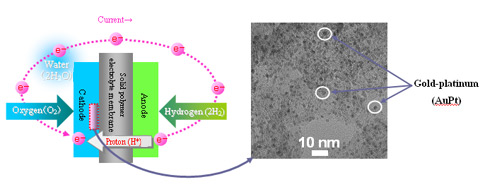 |
| An electron microscope photograph of a gold-platinum (AuPt) catalyst deposited on a conductive carbon support. The dark grey or black areas are the gold-platinum catalysts, and the light grey areas are the carbon support. The gold-platinum catalyst particles are 2 to 3 nanometer in size. |
Abstract:
—Achieving approximately 4.8 times*1 higher oxygen reduction
current per unit area compared to that of platinum—
Hitachi Maxell Develops New Highly-Active Catalyst for Higher Performance Fuel Cells; Achieves 4.8x More Oxygen-Reduction Current than Platinum
Tokyo, Japan | Posted on April 2nd, 2008Hitachi Maxell, Ltd. (TSE: 6810) has announced development of a new catalyst used for oxygen-reduction reactions at the cathode of a polymer electrolyte fuel cell (PEFC). The new catalyst is gold-platinum (AuPt) nano-particle 2 to 3 nm in size and can generate approximately 4.8 times the oxygen-reduction current per unit area than commercial platinum catalysts.
PEFCs are a promising clean-energy source for automobiles, homes, and mobile devices. Platinum is commonly used as the catalyst for the oxygen-reduction reaction in PEFCs, but platinum is an extremely expensive precious metal, so reducing material cost for PEFCs by minimizing the amount of platinum used, while improving its catalytic effect is an important R&D topic.
Increasing the surface area of the catalyst by reducing particle size is an effective way of improving catalytic activity. It has also been reported that the addition of base metals such as iron, cobalt and nickel to platinum also improves the oxygen-reduction reaction rate, but these kinds of base metals dissolve easily in the acidic environment of a PEFC where the catalyst is working, which is a problem.
Maxell has developed a new catalyst for oxygen-reduction reactions in PEFCs. The new catalyst is a composition of platinum and gold and is resistant to acidic environments. It was difficult to synthesize gold particles smaller than 5 nm due to its relatively low melting point, but by applying a proprietary nano-level particle synthesizing technology, Maxell has succeeded in developing a high-activity structure in which the gold and platinum are not fully alloyed for the new catalyst. Using citric acid as a reducing agent, AuPt catalyst particles 2 to 3 nm in size were synthesized at 373 K. Compared with platinum catalysts, this new AuPt catalyst achieves approximately 4.8 times higher oxygen-reduction current per unit area. X-ray diffraction analysis revealed that the gold and platinum are not fully alloyed and it is supposed that this structure results in the improved the oxygen-reduction reaction activity.
This success represents a large step closer to fuel cells that are practical for applications requiring large current, such as automobiles and homes.
Maxell presented this new technology for synthesizing a highly-active AuPt catalyst at the 101st catalysis conference held March 29 at the Tower Hall Funabori in Tokyo.
Maxell will continue nano-technology research and development towards practical applications in polymer-electrolyte and direct-methanol fuel cells.
####
About Hitachi Maxell, Ltd.
Since its foundation in 1960, Hitachi Maxell, Ltd. (TSE: 6810) has led the electronics industry at home and abroad in the fields of memory and mobility. Maxell is a leading manufacturer of information storage media products including magnetic tapes, optical disks, and battery products including lithium ion rechargeable batteries, micro batteries and dry cell batteries. For more information on Maxell, please visit the Company's web site at www.maxell.com .
For more information, please click here
Contacts:
Hitachi Maxell
Corporate Communications
Tel: +81-3-3515-8211
Copyright © Hitachi Maxell, Ltd.
If you have a comment, please Contact us.Issuers of news releases, not 7th Wave, Inc. or Nanotechnology Now, are solely responsible for the accuracy of the content.
Bookmark:


| Related News Press |
News and information
 Simulating magnetization in a Heisenberg quantum spin chain April 5th, 2024
NRL charters Navy’s quantum inertial navigation path to reduce drift April 5th, 2024
Discovery points path to flash-like memory for storing qubits: Rice find could hasten development of nonvolatile quantum memory April 5th, 2024
Announcements
NRL charters Navy’s quantum inertial navigation path to reduce drift April 5th, 2024
Discovery points path to flash-like memory for storing qubits: Rice find could hasten development of nonvolatile quantum memory April 5th, 2024
Energy
Development of zinc oxide nanopagoda array photoelectrode: photoelectrochemical water-splitting hydrogen production January 12th, 2024
Shedding light on unique conduction mechanisms in a new type of perovskite oxide November 17th, 2023
Inverted perovskite solar cell breaks 25% efficiency record: Researchers improve cell efficiency using a combination of molecules to address different November 17th, 2023
The efficient perovskite cells with a structured anti-reflective layer – another step towards commercialization on a wider scale October 6th, 2023
Automotive/Transportation
Researchers’ approach may protect quantum computers from attacks March 8th, 2024
Tests find no free-standing nanotubes released from tire tread wear September 8th, 2023
Fuel Cells
Current and Future Developments in Nanomaterials and Carbon Nanotubes: Applications of Nanomaterials in Energy Storage and Electronics October 28th, 2022
 |
||
 |
||
| The latest news from around the world, FREE | ||
 |
||
|
|
||
| Premium Products | ||
 |
||
|
Only the news you want to read!
Learn More |
||
 |
||
|
Full-service, expert consulting
Learn More |
||
|
|
||