Home > Press > INBT Offers Valuable Undergraduate NanoBio Research Opportunity
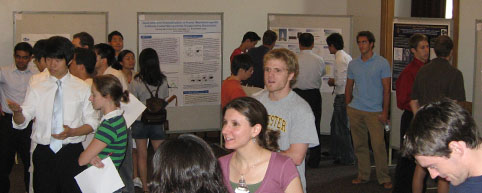 |
| Research Experience for Undergraduates poster session 2007. Credit: INBT / JHU |
Abstract:
Undergraduate research experience provides students with lasting benefits. The Johns Hopkins Institute for NanoBioTechnology is pleased to offer a 10-week summer NanoBio research experience for undergraduates (REU) funded by a grant from the National Science Foundation.
INBT Offers Valuable Undergraduate NanoBio Research Opportunity
Baltimore, MD | Posted on January 29th, 2008INBT's NanoBio REU exposes students to lab-based scientific research. Students may opt to work in the research areas of biomaterials, drug/gene delivery, stem cells and cell engineering, nanofabrication, and cancer, among other topics and work side-by-side with INBT affiliated faculty and graduate mentors. They gain hands-on laboratory experience, participate in professional development seminars, and present their results at a final poster session.
In addition, students will earn a $3,500 stipend and an allowance for housing, living expenses, and the cost of travel to and from their homes to Johns Hopkins University. Applications for INBT's NanoBio REU will be accepted until Feb. 15, 2008. Undergraduates who have completed their sophomore or junior year and who are U.S. citizens or permanent residents are eligible to apply.
Studies show that students who took advantage of such opportunities noted "gains in independence, intrinsic motivation to learn, and active participation in courses taken after the summer undergraduate research experience" (Lopatto, 2007). A 2001 survey of 136 liberal arts colleges reported that the number of students participating in undergraduate research has risen by 70% in the last 10 years (Mervis, 2001), while those students seeking more intensive summer research program (such as the one offered by INBT) has increased by 40%.
For more information, go to inbt.jhu.edu/reu. Or contact education program coordinator, Ashanti Edwards, at .
References
Lopatto, David (2007). Undergraduate Research Experiences Support Science Career Decisions and Active Learning. CBE Life Sci Educ 6, 297-306.
Mervis, Jeffrey (31 August 2001). Student Research: What Is It Good For?
Science 293 (5535), 1614. [DOI: 10.1126/science.293.5535.1614]
####
About Institute for NanoBioTechnology
The Institute for NanoBioTechnology at Johns Hopkins University is revolutionizing health care by bringing together internationally renowned expertise in medicine, engineering, the sciences, and public health to create new knowledge and groundbreaking technologies.
INBT programs in research, education, outreach, and technology transfer are designed to foster the next wave of nanobiotechnology innovation.
Approximately 150 faculty are affiliated with INBT and are also members of the following Johns Hopkins institutions: Krieger School of Arts and Sciences, Whiting School of Engineering, School of Medicine, Bloomberg School of Public Health, and Applied Physics Laboratory.
For more information, please click here
Contacts:
Ashanti Edwards
Copyright © Institute for NanoBioTechnology
If you have a comment, please Contact us.Issuers of news releases, not 7th Wave, Inc. or Nanotechnology Now, are solely responsible for the accuracy of the content.
Bookmark:


| Related News Press |
News and information
 Simulating magnetization in a Heisenberg quantum spin chain April 5th, 2024
NRL charters Navy’s quantum inertial navigation path to reduce drift April 5th, 2024
Discovery points path to flash-like memory for storing qubits: Rice find could hasten development of nonvolatile quantum memory April 5th, 2024
Academic/Education
Rice University launches Rice Synthetic Biology Institute to improve lives January 12th, 2024
Multi-institution, $4.6 million NSF grant to fund nanotechnology training September 9th, 2022
Announcements
NRL charters Navy’s quantum inertial navigation path to reduce drift April 5th, 2024
Discovery points path to flash-like memory for storing qubits: Rice find could hasten development of nonvolatile quantum memory April 5th, 2024
Nanobiotechnology
New micromaterial releases nanoparticles that selectively destroy cancer cells April 5th, 2024
Good as gold - improving infectious disease testing with gold nanoparticles April 5th, 2024
Researchers develop artificial building blocks of life March 8th, 2024
 |
||
 |
||
| The latest news from around the world, FREE | ||
 |
||
|
|
||
| Premium Products | ||
 |
||
|
Only the news you want to read!
Learn More |
||
 |
||
|
Full-service, expert consulting
Learn More |
||
|
|
||