Home > Press > Nanotech center provides cutting-edge tools for research
 |
| Photo by Daniel Kim.
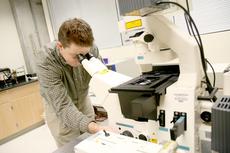
Paul Wallace demonstrates the use of a confocal microscope. He specializes in optical microscopes and image processing. |
Abstract:
In what people are calling the millennium of the miniscule, the University of Washington will not be left behind.
Nanotech center provides cutting-edge tools for research
Seattle, WA | Posted on January 25th, 2008The Center for Nanotechnology, located in Fluke Hall, houses state-of-the-art machinery and experts for research into the microworld.
"Technically we fall under chemical engineering," said Mack Carter, the center's program manager. But with faculty from colleges as varied as Arts and Sciences, Engineering, and Medicine, the center occupies a world of its own.
The Center for Nanotechnology is a member of the National Nanotechnology Infrastructure Network (NINN). NNIN is an integrated partnership of 13 user facilities supported by the National Science Foundation, providing "unparalleled opportunities for nanoscience and nanotechnology research," according to its Web site.
Other members of the network include the NanoScale Science and Technology Facility at Cornell University and the Stanford Nanofabrication Facility at Stanford University.
"The center not only serves the UW but also plays an important role for industry," said Qiuming Yu, the lab manager for the UW's nanotech facility.
Through NINN, the UW provides an open laboratory where anyone can pay an hourly rate to use the center's tools and equipment. Additionally, lab users receive support and training from the center's expert staff, who are able to help with a variety of issues.
Each facility has a specialty in terms of equipment and expertise, which ensures that users of NINN will have access to a wider variety of tools. The UW is focusing on the area of nanotechnology with applications to biology.
While the Center for Nanotechnology mainly serves the UW, it has had a wide variety of external users in both smaller and larger companies. Major stakeholders include Lumera and Carbon Nanoprobes Inc. There are close to 20 companies using the facility.
"Many small businesses can't afford the necessary equipment to conduct research [into nanotechnology]," Yu said.
Although having other companies use the resources of the center reduces the lab time available to the UW, the Center for Nanotechnology provides small companies and researchers access to tools that would otherwise not be affordable, allowing for rapid advancement of technologies and sciences on the nanoscale.
"Costs are low, and their results can be immediate," Carter said of the small companies' expenses.
Like the companies themselves, the research emerging from the center is varied in its nature and application. Some research highlights include disease diagnostic and treatment technologies, bio-inspired hybrid materials and quantum structures.
The Center for Nanotechnology is planning on expanding its lab space, doubling its square footage to 3,000 square feet. This will increase the number of tools and technologies available to users of the facility.
The center is becoming more widely known to companies in the area, Carter said.
"With over 80 faculty associated with the center and access to NINN, we have substantial brainpower," he said.
####
About University of Washington
The primary mission of the University of Washington is the preservation, advancement, and dissemination of knowledge. The University preserves knowledge through its libraries and collections, its courses, and the scholarship of its faculty. It advances new knowledge through many forms of research, inquiry and discussion; and disseminates it through the classroom and the laboratory, scholarly exchanges, creative practice, international education, and public service. As one of the nation's outstanding teaching and research institutions, the University is committed to maintaining an environment for objectivity and imaginative inquiry and for the original scholarship and research that ensure the production of new knowledge in the free exchange of facts, theories, and ideas.
For more information, please click here
Contacts:
Lauren Bond
Copyright © University of Washington
If you have a comment, please Contact us.Issuers of news releases, not 7th Wave, Inc. or Nanotechnology Now, are solely responsible for the accuracy of the content.
Bookmark:


| Related News Press |
News and information
 Simulating magnetization in a Heisenberg quantum spin chain April 5th, 2024
NRL charters Navy’s quantum inertial navigation path to reduce drift April 5th, 2024
Discovery points path to flash-like memory for storing qubits: Rice find could hasten development of nonvolatile quantum memory April 5th, 2024
Laboratories
A battery’s hopping ions remember where they’ve been: Seen in atomic detail, the seemingly smooth flow of ions through a battery’s electrolyte is surprisingly complicated February 16th, 2024
NRL discovers two-dimensional waveguides February 16th, 2024
Three-pronged approach discerns qualities of quantum spin liquids November 17th, 2023
Academic/Education
Rice University launches Rice Synthetic Biology Institute to improve lives January 12th, 2024
Multi-institution, $4.6 million NSF grant to fund nanotechnology training September 9th, 2022
Announcements
NRL charters Navy’s quantum inertial navigation path to reduce drift April 5th, 2024
Discovery points path to flash-like memory for storing qubits: Rice find could hasten development of nonvolatile quantum memory April 5th, 2024
Tools
Ferroelectrically modulate the Fermi level of graphene oxide to enhance SERS response November 3rd, 2023
The USTC realizes In situ electron paramagnetic resonance spectroscopy using single nanodiamond sensors November 3rd, 2023
 |
||
 |
||
| The latest news from around the world, FREE | ||
 |
||
|
|
||
| Premium Products | ||
 |
||
|
Only the news you want to read!
Learn More |
||
 |
||
|
Full-service, expert consulting
Learn More |
||
|
|
||