Home > Press > Piezo Beam Steering Mirror Platforms Provide Larger Angles, High Bandwidth & Stability
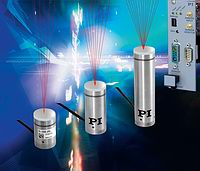 |
| S-330 piezo sterring mirror platforms shown with a closed-loop OEM piezo controller |
Abstract:
PI (Physik Instrumente) L.P. — a leading manufacturer of nanopositioning and piezo-based precision motion-control equipment for bio-nanotechnology, photonics and semiconductor applications—has extended the S-330 high-dynamics piezo tip/tilt platform family by several new large-angle models.
Piezo Beam Steering Mirror Platforms Provide Larger Angles, High Bandwidth & Stability
Auburn, MA | Posted on December 17th, 2007Features & Advantages:
- Six Closed Loop & Open Loop Models for Mirrors up to 50 mm Diameter
- Optical Beam Deflection to 20 mrad (>1°)
- > 3kHz Resonant Frequency for Sub-Millisecond Step Response
- Resolution to 20 nrad — Excellent Position Stability
- Parallel-Kinematics Design for Higher Dynamics, Stability & Linearity
- Closed-Loop Versions for Better Linearity
- Differential Drives for Excellent Temperature Stability
Typical Applications
Beam correction, laser surgery, image stabilization, interlacing, dithering, laser scanning / beam steering, optical communications, high resolution microscopy / spectroscopy
2-Axis, Flexure Guided, No Polarization Rotation
S-330 steering mirror platforms provide precise angular tip/tilt motion of the top platform around two orthogonal axes. These flexure-guided, piezoelectrically driven systems can provide higher accelerations than other actuators, enabling step response times in the sub-millisecond range.
The single pivot-point design also prevents the drawback of polarization rotation, which is common with conventional 2-axis stacked systems, e.g. galvo scanners.
Closed-loop and open-loop versions with 3 different tilt ranges up to 10 mrad (20 mrad optical deflection) are available.
Parallel-Kinematics: Smaller with Improved Stability, Linearity & Dynamics
PI piezo steering mirrors are based on a parallel-kinematics design with coplanar rotational axes and a single moving platform driven by two pairs of differential actuators. The advantage is jitter-free, multi-axis motion with excellent temperature stability. Compared to stacked (two-stage), mirror scanners, the parallel-kinematics design provides symmetrical dynamic performance in both axes with faster response and better linearity in a smaller package.
####
About PI (Physik Instrumente) L.P.
PI is a leading manufacturer of ultra-precision motion-control equipment for photonics, nanotechnology, semiconductor and life science applications. PI has been developing and manufacturing standard & custom precision products with piezoelectric and electromagnetic drives for 35+ years. The company has been ISO 9001 certified since 1994 and provides innovative, high-quality solutions for OEM and research. PI is present worldwide with eight subsidiaries and total staff of 450+.
For more information, please click here
Contacts:
Stefan Vorndran
Dir. Corp. Product Marketing & Communications
-----------------------------
PI (Physik Instrumente) L.P.
16 Albert St.
Auburn, MA 01501
email:
Tel: 508-832-3456,
Fax: 508-832-0506
http://www.pi.ws
http://www.pi-usa.us
Copyright © PI (Physik Instrumente) L.P.
If you have a comment, please Contact us.Issuers of news releases, not 7th Wave, Inc. or Nanotechnology Now, are solely responsible for the accuracy of the content.
Bookmark:


| Related News Press |
Announcements
 NRL charters Navy’s quantum inertial navigation path to reduce drift April 5th, 2024
Discovery points path to flash-like memory for storing qubits: Rice find could hasten development of nonvolatile quantum memory April 5th, 2024
Tools
Ferroelectrically modulate the Fermi level of graphene oxide to enhance SERS response November 3rd, 2023
The USTC realizes In situ electron paramagnetic resonance spectroscopy using single nanodiamond sensors November 3rd, 2023
 |
||
 |
||
| The latest news from around the world, FREE | ||
 |
||
|
|
||
| Premium Products | ||
 |
||
|
Only the news you want to read!
Learn More |
||
 |
||
|
Full-service, expert consulting
Learn More |
||
|
|
||