Home > Press > UPS to Use ZAP Electric Car and Truck Fleet for Deliveries
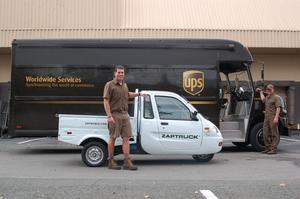 |
| Brown Goes Green - UPS rolled out an electric car and truck fleet from ZAP this week to help with small parcel deliveries in dense urban communities. The move was made to reduce fuel consumption and reduce CO2 emissions. See today's press release for a photo gallery of the electric vehicles in operation. |
Abstract:
It will be a green holiday this season for United Parcel Service (UPS), who rolled out a small parcel delivery service this week in Northern California using 42 electric cars and trucks from ZAP (OTCBB: ZAAP).
UPS to Use ZAP Electric Car and Truck Fleet for Deliveries
PETALUMA, CA | Posted on November 13th, 2007The UPS branch in Petaluma, California has leased an initial fleet of 42 ZAP Xebra® electric city cars and trucks for their small parcel deliveries. This is the first time that UPS has used electric city-speed vehicles for this purpose.
View a photo gallery of the vehicles in operation on Flickr at the URL below: writeEmail('N05/sets/72157603132407291"','href="http://www.flickr.com/photos/20464296'); target="_blank" onClick="return
Small parcel deliveries are becoming more challenging for the trademark big, brown UPS delivery vans, which is why UPS is using the electric city cars and trucks to handle small parcel deliveries. The ZAP vehicles lessen fuel consumption and reduce automotive emissions produced by current delivery vehicles. Drivers will be monitoring their electrical usage to carefully analyze cost-savings and emissions reductions.
"This is the missing link for small package deliveries in congested areas," said ZAP CEO Steve Schneider. "Packages go from the airplanes, to the tractor trailers, to the delivery vans, then to the drop-off nodes. From there the ZAP trucks make the final delivery to the consumer in a zero-emission vehicle that costs less to operate. It's a perfect example of how green technology can help corporate America's bottom line."
UPS is setting up strategic distribution nodes where vans can transfer packages to the ZAP Xebras for final delivery in smaller communities, neighborhoods and downtown areas where larger delivery vans are less efficient and have a more difficult time navigating or parking.
"ZAP vehicles are much better than full size trucks in urban areas because they can save a fleet operator money," said ZAP Chairman Gary Starr. "Electric vehicles can also be one of the best things any organization can do to cut greenhouse gases and help the environment."
A publicly owned automotive manufacturer and distributor based in nearby Santa Rosa, California, ZAP specializes in energy-efficient transportation technologies. The ZAP Xebra was designed as an economical electric city car that can handle city-speed driving up to 40 MPH for daily urban driving, commuting as well as light duty government and corporate fleet applications. ZAP cars and trucks are believed to be the only 40 MPH street-legal electric vehicles available in production today and sell for a little over $10,000 with a cost of about three cents per mile for electricity. Studies show that electric vehicles reduce automotive emissions by more than 90 percent compared to gasoline vehicles, including the emissions from power plants.
About UPS
Founded in 1907 as a messenger company, UPS has grown into a $47.5 billion corporation by focusing on the goal of enabling global commerce. It has become the world's largest package delivery company and a leading provider of specialized transportation and logistics services. Every day UPS manages the flow of goods, funds, and information in more than 200 countries and territories worldwide. UPS employs 427,700 people delivering 3.9 million packages annually. UPS operates 1,788 facilities with an overall vehicle fleet of 94,542 package cars, vans, tractors, and motorcycles. UPS also operates a fleet of 277 aircraft, making it the 9th largest airline.
####
About ZAP
ZAP has been a leader in advanced transportation technologies since 1994, delivering over 100,000 vehicles to consumers in more than 75 countries. At the forefront of fuel-efficient transportation with new technologies including energy efficient gas systems, hydrogen, electric, fuel cell, ethanol, hybrid and other innovative power systems, ZAP has a joint venture to manufacture electric and hybrid vehicles with Youngman Automotive Group, one of China's leading manufacturers of buses and trucks. ZAP is developing a high-performance crossover SUV electric car concept called ZAP-X engineered by Lotus Engineering. ZAP is also developing a new generation of vehicles using advanced nanotech batteries with Advanced Battery Technologies (AMEX: GBT). The Company recently announced a strategic partnership with Dubai-based Al Yousuf Group to expand its international vehicle distribution. ZAP also makes an innovative, new portable energy technology that manages power for mobile electronics from cell phones to laptops. For product, dealer and investor information, visit http://www.zapworld.com .
Forward-looking statements in this release are made pursuant to the "safe harbor" provisions of the Private Securities Litigation Reform Act of 1995. Investors are cautioned that such forward-looking statements involve risks and uncertainties, including, without limitation, continued acceptance of the Company's products, increased levels of competition for the Company, new products and technological changes, the Company's dependence upon third-party suppliers, intellectual property rights, and other risks detailed from time to time in the Company's periodic reports filed with the Securities and Exchange Commission.
For more information, please click here
Contacts:
ZAP
Alex Campbell
707-525-8658
Copyright © Market Wire
If you have a comment, please Contact us.Issuers of news releases, not 7th Wave, Inc. or Nanotechnology Now, are solely responsible for the accuracy of the content.
Bookmark:


| Related News Press |
Announcements
 NRL charters Navy’s quantum inertial navigation path to reduce drift April 5th, 2024
Discovery points path to flash-like memory for storing qubits: Rice find could hasten development of nonvolatile quantum memory April 5th, 2024
Automotive/Transportation
Researchers’ approach may protect quantum computers from attacks March 8th, 2024
Tests find no free-standing nanotubes released from tire tread wear September 8th, 2023
Battery Technology/Capacitors/Generators/Piezoelectrics/Thermoelectrics/Energy storage
What heat can tell us about battery chemistry: using the Peltier effect to study lithium-ion cells March 8th, 2024
A battery’s hopping ions remember where they’ve been: Seen in atomic detail, the seemingly smooth flow of ions through a battery’s electrolyte is surprisingly complicated February 16th, 2024
New-Contracts/Sales/Customers
Bruker Light-Sheet Microscopes at Major Comprehensive Cancer Center: New Advanced Imaging Center Powered by Two MuVi and LCS SPIM Microscopes March 25th, 2021
Arrowhead Pharmaceuticals Announces Closing of Agreement with Takeda November 27th, 2020
Veeco Announces Aledia Order of 300mm MOCVD Equipment for microLED Displays: Propel™ Platform First 300mm System with EFEM Designed for Advanced Display Applications October 20th, 2020
GREENWAVES TECHNOLOGIES Announces Next Generation GAP9 Hearables Platform Using GLOBALFOUNDRIES 22FDX Solution October 16th, 2020
 |
||
 |
||
| The latest news from around the world, FREE | ||
 |
||
|
|
||
| Premium Products | ||
 |
||
|
Only the news you want to read!
Learn More |
||
 |
||
|
Full-service, expert consulting
Learn More |
||
|
|
||