Home > Press > Photonic Gel Films Hold Promise
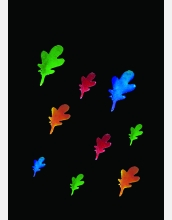 |
| Photonic gel crystals demonstrate the "tunability" of materials made from alternating layers of hard and soft polymers. The soft polymers are easily swollen with liquid or vapor, causing the materials to reflect different colors of light based on the way their molecules are chemically "tuned".
Credit: Courtesy of Edwin L. Thomas, MIT |
Abstract:
By alternating layers of two different polymers - one rigid and glassy, the other soft and easily swollen with liquid or vapor - researchers funded by the National Science Foundation (NSF) report they've created photonic gel crystals that can be tuned to reflect light of many different colors across the visible and near-infrared spectrum.
Photonic Gel Films Hold Promise
Cambridge, MA | Posted on October 21st, 2007The research results, reported in the Oct. 21 online issue of Nature Materials by Principal Investigator Edwin Thomas and his colleagues at the Massachusetts Institute of Technology's department of materials science and engineering, demonstrate the degree to which these photonic materials are tunable through changes in the soft layer's thickness and index of refraction. The responsiveness of the photonic crystals makes them likely candidates for active components of display, sensory or telecommunication devices.
"This is an ingenious and easy-to-implement method for making photonic materials whose optical properties can be readily tuned over a wide range [of the spectrum]," said Andrew Lovinger, director of the polymers program at NSF, which funded this research.
In one example, the researchers show very large, reversible optical changes by varying the salt content of a water solution in which these films are dipped. Multicolor patterns can be made by sequential coating of films, with the color of each region depending on the degree to which their molecules are chemically interconnected.
"We expect these photonic gels will lead to many novel applications, including colorimetric sensors, active components of simple display devices, and electrically controlled tunable optically pumped lasers, photonic switches and multiband filters," Thomas said.
NSF funded the research in 2003 through a three-year grant aimed at creating new nanomaterials that are tunable through magnetic, chemical or other techniques. Following the discovery of intriguing new effects by Thomas and his colleagues involving the interaction of light and sound in these nanomaterials, his grant was extended for two additional years through a "special creativity award."
-NSF-
####
About National Science Foundation
The National Science Foundation (NSF) is an independent federal agency that supports fundamental research and education across all fields of science and engineering, with an annual budget of $5.92 billion. NSF funds reach all 50 states through grants to over 1,700 universities and institutions. Each year, NSF receives about 42,000 competitive requests for funding, and makes over 10,000 new funding awards. The NSF also awards over $400 million in professional and service contracts yearly.
For more information, please click here
Contacts:
Media Contacts
Diane E. Banegas
NSF
(703) 292-8070
Anne Trafton
Massachusetts Institute of Technology
(617) 253-6936
Program Contacts
Andrew Lovinger
National Science Foundation
(703) 292-4933
Principal Investigators
Edwin Thomas
Massachusetts Institute of Technology
617-253-6901
Copyright © National Science Foundation
If you have a comment, please Contact us.Issuers of news releases, not 7th Wave, Inc. or Nanotechnology Now, are solely responsible for the accuracy of the content.
Bookmark:


| Related Links |
 Science and Engineering Statistics
| Related News Press |
Display technology/LEDs/SS Lighting/OLEDs
Utilizing palladium for addressing contact issues of buried oxide thin film transistors April 5th, 2024
Light guide plate based on perovskite nanocomposites November 3rd, 2023
Simple ballpoint pen can write custom LEDs August 11th, 2023
Novel design perovskite electrochemical cell for light-emission and light-detection May 12th, 2023
Govt.-Legislation/Regulation/Funding/Policy
NRL charters Navy’s quantum inertial navigation path to reduce drift April 5th, 2024
Discovery points path to flash-like memory for storing qubits: Rice find could hasten development of nonvolatile quantum memory April 5th, 2024
Chemical reactions can scramble quantum information as well as black holes April 5th, 2024
Sensors
Discoveries
Chemical reactions can scramble quantum information as well as black holes April 5th, 2024
New micromaterial releases nanoparticles that selectively destroy cancer cells April 5th, 2024
Utilizing palladium for addressing contact issues of buried oxide thin film transistors April 5th, 2024
Announcements
NRL charters Navy’s quantum inertial navigation path to reduce drift April 5th, 2024
Discovery points path to flash-like memory for storing qubits: Rice find could hasten development of nonvolatile quantum memory April 5th, 2024
Grants/Sponsored Research/Awards/Scholarships/Gifts/Contests/Honors/Records
Discovery points path to flash-like memory for storing qubits: Rice find could hasten development of nonvolatile quantum memory April 5th, 2024
Chemical reactions can scramble quantum information as well as black holes April 5th, 2024
Photonics/Optics/Lasers
With VECSELs towards the quantum internet Fraunhofer: IAF achieves record output power with VECSEL for quantum frequency converters April 5th, 2024
Nanoscale CL thermometry with lanthanide-doped heavy-metal oxide in TEM March 8th, 2024
Optically trapped quantum droplets of light can bind together to form macroscopic complexes March 8th, 2024
HKUST researchers develop new integration technique for efficient coupling of III-V and silicon February 16th, 2024
 |
||
 |
||
| The latest news from around the world, FREE | ||
 |
||
|
|
||
| Premium Products | ||
 |
||
|
Only the news you want to read!
Learn More |
||
 |
||
|
Full-service, expert consulting
Learn More |
||
|
|
||