Home > Press > PI New Product Release: Smallest Precision Translation Stage w/ Ballscrew Drive & Optical Linear Encoder
 |
Abstract:
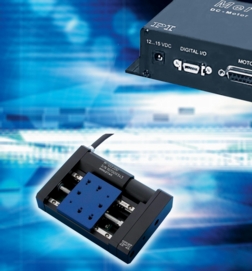
PI (Physik Instrumente) L.P. — a leading manufacturer of nanopositioning and precision motion-control equipment for bio-nanotechnology, photonics and semiconductor applications — introduces the M-122 palm-top-sized precision translation stage which combines compact dimensions, high dynamics & speed and very high accuracy at a competitive price.
PI New Product Release: Smallest Precision Translation Stage w/ Ballscrew Drive & Optical Linear Encoder
Auburn, MA | Posted on August 23rd, 2007Features & Advantages:
- Long Travel Range: 1 Inch (25 mm)
- Very Compact: Smallest Ballscrew Driven Stage w/ Linear Encoder: 60x86x20 mm
- High Dynamics & Speed: Servo Motor Direct Drive provides up to 20 mm/sec, Significantly Better Dynamic Response than Stepper Motor Drives
- Precise: 0.1 Micron Resolution Optical Linear Encoder for Higher Linearity & Repeatability
- Cross-Roller Bearings for High Load Capacity & Excellent Guiding Accuracy
- Long Life & Low Maintenance: Recirculating Ball Screw Provides High Speed & Long Lifetime
Typical Applications: Metrology, Quality Assurance, Testing Equipment, Micromachining, Photonics Packaging, Fiber Positioning,
Smallest Ballscrew-Driven Stage with Linear Encoder
The M-122 features a space-saving, folded drive train with the servo motor and drive screw side-by-side. Equipped with a non-contacting optical linear encoder and a preloaded, precision-ground, ball-screw, these stages can provide much higher accuracy, better repeatability and dynamic performance than conventional stepper motor stages or rotary encoder-equipped servo motor stages.
Cost Effective Controllers
M-122 stages can be driven with the low-cost, networkable, C-862 Mercury™ servo motor controller/driver. For multiaxis applications, the C-843 PC Board is available.
Compact XY and XYZ Combinations
M-122 stages can be combined to very compact XY and XYZ systems.
Low Friction, High Speed, Maintenance-Free
Due to its low-friction, the backlash-free ball screw yields significantly higher mechanical efficiency than leadscrews, and allows maintenance-free, high duty-cycle operation at high velocities up to 20 mm/sec.
####
About PI (Physik Instrumente) L.P.
PI is a leading manufacturer of nanopositioning and precision motion-control equipment for photonics, nanotechnology, semiconductor and life science applications. PI has been developing and manufacturing standard & custom precision products with piezoelectric and electromagnetic drives for 35+ years. The company has been ISO 9001 certified since 1994 and provides innovative, high-quality solutions for OEM and research. PI is present worldwide with eight subsidiaries and total staff of 450+.
For more information, please click here
Contacts:
Stefan Vorndran
Dir. Corp. Product Marketing & Communications
-----------------------------
PI (Physik Instrumente) L.P.
16 Albert St.
Auburn, MA 01501
email:
Tel: 508-832-3456,
Fax: 508-832-0506
http://www.pi.ws
http://www.pi-usa.us
Copyright © PI (Physik Instrumente) L.P.
If you have a comment, please Contact us.Issuers of news releases, not 7th Wave, Inc. or Nanotechnology Now, are solely responsible for the accuracy of the content.
Bookmark:


| Related News Press |
Announcements
 NRL charters Navy’s quantum inertial navigation path to reduce drift April 5th, 2024
Discovery points path to flash-like memory for storing qubits: Rice find could hasten development of nonvolatile quantum memory April 5th, 2024
Tools
Ferroelectrically modulate the Fermi level of graphene oxide to enhance SERS response November 3rd, 2023
The USTC realizes In situ electron paramagnetic resonance spectroscopy using single nanodiamond sensors November 3rd, 2023
 |
||
 |
||
| The latest news from around the world, FREE | ||
 |
||
|
|
||
| Premium Products | ||
 |
||
|
Only the news you want to read!
Learn More |
||
 |
||
|
Full-service, expert consulting
Learn More |
||
|
|
||