Home > Press > CMU-RC and Dendritic Nanotechnologies launch research to purify ground water
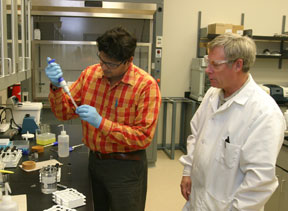 |
| Formulation scientist Abhay Chauhan and producing chemist Doug Swanson of Dendritic Nanotechnologies Inc. produce a sample of dendrimers for fluorescence spectroscopy at CMU’s Center for Applied Research and Technology. Dendrimer-based nanotechnology will be utilized in the creation of an advanced water purification system.
Photo by Robert Barclay CMU Public Relations and Marketing |
Abstract:
Central Michigan University Research Corporation and Dendritic Nanotechnologies Inc. have developed technology capable of absorbing toxic chemicals from ground water that could lead to a revolutionary ground water purification system.
CMU-RC and Dendritic Nanotechnologies launch research to purify ground water
MOUNT PLEASANT, MI | Posted on August 13th, 2007The U.S. Department of Defense's Strategic Environmental Research and Development Program has awarded CMU-RC and DNT a $1.3 million contract to refine the process using DNT's Priostar dendrimer-based nanotechnology.
The project focuses on a worldwide breakthrough that will result in a cost effective ground water purification system. Its anticipated commercial launch is set for September 2008. Plans call for the manufacturing, sales and technical support systems to be housed in Michigan.
The initial ground water purification target is perchlorate, a chemical that has contaminated the groundwater in some areas of the country. The Centers for Disease Control and Prevention has reported that low levels of perchlorate are widespread throughout the U.S., and 27 U.S. Department of Defense facilities have been identified as having perchlorate contamination. This type of contamination potentially affects the health of millions of women, as perchlorate interferes with iodide absorption by the thyroid gland.
Ground water accounts for about 50 percent of the nation's municipal, domestic and agricultural water supply. When polluted, it can endanger public health or threaten the environment.
The novel nanoscale dendritic polymer technologies were developed in Mount Pleasant by DNT and will be refined by Central Michigan University faculty in the National Dendrimer Center. Michigan leads the nation in dendritic polymer research and product development.
"Not only will this technology serve the legislative and environmental requirements of the U.S. Department of Defense in a cost effective manner, it will easily transition into the public sector," said Robert Berry, president of DNT. "The economic need for a water remediation and recovery system that is cost effective, recovers precious metals for recycling, and releases water that exceeds the Clean Water Act standards back into the environment will be highly desired worldwide."
####
About Central Michigan University Research Corporation and Dendritic Nanotechnologies Inc.
Dendritic Nanotechnologies, a wholly owned subsidiary of Starpharma Holdings Limited, was recruited by CMU-RC to become part of its Mount Pleasant SmartZone, a 300-acre technology park authorized by the Michigan Economic Development Corporation. The area has been designed to attract and stimulate the growth of high-tech businesses that require a synergistic relationship with doctoral/research institutions like CMU.
For more information, please click here
Contacts:
MEDIA CONTACT:
Kristi DePaul
989-774-1072
PROGRAM CONTACT:
Robert Berry
989-774-1799
Copyright © Central Michigan University
If you have a comment, please Contact us.Issuers of news releases, not 7th Wave, Inc. or Nanotechnology Now, are solely responsible for the accuracy of the content.
Bookmark:


| Related News Press |
Govt.-Legislation/Regulation/Funding/Policy
 NRL charters Navy’s quantum inertial navigation path to reduce drift April 5th, 2024
Discovery points path to flash-like memory for storing qubits: Rice find could hasten development of nonvolatile quantum memory April 5th, 2024
Chemical reactions can scramble quantum information as well as black holes April 5th, 2024
Announcements
NRL charters Navy’s quantum inertial navigation path to reduce drift April 5th, 2024
Discovery points path to flash-like memory for storing qubits: Rice find could hasten development of nonvolatile quantum memory April 5th, 2024
Water
Taking salt out of the water equation October 7th, 2022
Research partnerships
Discovery points path to flash-like memory for storing qubits: Rice find could hasten development of nonvolatile quantum memory April 5th, 2024
Researchers’ approach may protect quantum computers from attacks March 8th, 2024
'Sudden death' of quantum fluctuations defies current theories of superconductivity: Study challenges the conventional wisdom of superconducting quantum transitions January 12th, 2024
 |
||
 |
||
| The latest news from around the world, FREE | ||
 |
||
|
|
||
| Premium Products | ||
 |
||
|
Only the news you want to read!
Learn More |
||
 |
||
|
Full-service, expert consulting
Learn More |
||
|
|
||