Home > Press > Scientists Discover New Way to Study Nanostructures
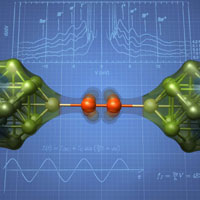 |
| Atomic-scale mechanical motions in nanowires can be excited by high-frequency alternating superconducting Josephson currents. In niobium dimer nanowires three vibrational modes were experimentally observed and identified through first-principles theoretical calculations. At top is a curve of the measured conductance plotted versus applied voltage showing a sequence of peaks corresponding to vibrational modes of the dimer of niobium atoms suspended between the left and right tip-electrodes, as depicted in the atomic configuration shown in the middle. (Image: Georgia Tech/Alexei Marchenkov and Uzi Landman) |
Abstract:
Scientists at the Georgia Institute of Technology have discovered a phenomenon which allows measurement of the mechanical motion of nanostructures by using the AC Josephson effect. The findings, which may be used to identify and characterize structural and mechanical properties of nanoparticles, including materials of biological interest, appear online in the journal Nature Nanotechnology.
Scientists Discover New Way to Study Nanostructures
Atlanta, GA | Posted on July 24th, 2007The AC Josephson effect refers to work that Brian Josephson published in 1962 regarding the flow of an electrical current between superconductors. In this work, for which he shared a 1973 Nobel Prize, Josephson predicted that when a constant voltage difference is maintained across two weakly linked superconductors separated by a thin insulating barrier (an arrangement now known as a Josephson junction), an alternating electrical current would flow through the junction (imagine turning on a water faucet and having the water start flowing up as well as down once it leaves the spigot). The frequency of the current oscillations is directly related to the applied voltage.
These predictions were fully confirmed by an immense number of experiments, and the standard volt is now defined in terms of the frequency of the Josephson AC current. The Josephson effect has numerous applications in physics, computing and sensing technologies. It can be used for ultra high sensitive detection of electromagnetic radiation, extremely weak magnetic fields and in superconducting quantum computing bits.
Now, experimental physicist Alexei Marchenkov and theoretician Uzi Landman at Georgia Tech have discovered that the AC Josephson effect can be used to detect mechanical motion of atoms placed in the Josephson junction.
"We show here that in addition to being able to detect the effects of electromagnetic radiation on the AC Josephson current, one can also use it to probe mechanical motions of atoms or molecules placed in the junction," said Landman, director of the Center for Computational Materials Science, Regents and Institute professor, and Callaway
Chair of Physics at Georgia Tech. "The prospect of being able to explore, and perhaps utilize, atomic-scale phenomena using this effect is very exciting."
In January 2007, Marchenkov and Landman published a paper in Physical Review Letters detailing their discovery that fluctuations in the conductance of ultra-thin niobium nanowires are caused by a pair of atoms, known as a dimer, shuttling back and forth between the bulk electrical leads.
In this latest research, Marchenkov and Landman, along with their collaborators Zhenting Dai, Brandon Donehoo and Robert Barnett, report that when a microfabricated junction assembly is held below its superconducting transition temperature, unusual features are found in traces of the electrical conductance measured as a function of the applied voltage.
"In our experiments, only nanowires - which we know now to contain a single dimer have consistently shown a series of additional peaks in the conductance versus voltage curves. Since a peak in such measurements signifies a resonance and knowing that we have intrinsic high-frequency Josephson current oscillations, we started looking into the possible physical mechanisms," said Marchenkov, assistant professor in the School of Physics.
The team hypothesized that the new measured peaks likely originate from mechanical motions of the dimer, which causes enhancement of the electrical current at particular values of the applied voltage. At each of the peak voltages, the frequency of the AC Josephson current would resonate with the vibrational frequency of the nanostructure in the junction.
Subsequent first principles calculations by Landman's team predicted that such peaks would occur at three different frequencies, or voltages, and their integer multiples. One corresponds to a back and forth vibration of the dimer suspended between the two niobium electrode tips, a second corresponds to motion in the direction perpendicular to the axis connecting the two tips, and the remaining corresponds to a wagging, or rocking, vibration of the dimer about the inter-tip axis. Ensuing targeted experiments demonstrated that the resonance peaks disappear gradually as one approaches the superconducting transition temperature from below, while their positions do not change. These observations, exhaustive qualitative and quantitative agreement between experimental measurements and theoretical predictions confirm that vibrational motions of the nanowire atoms are indeed the cause for the newly observed conductance peaks.
Marchenkov and Landman plan to further explore vibrational effects in weak link junctions, using the information obtained through these studies for determining vibrational characteristics, atomic arrangements, and transport mechanisms in metallic,
organic and biomolecular nanostructures.
"One of our aims is the development of devices and sensing methodologies that utilize the insights gained from our research," said Landman.
####
About Georgia Institute of Technology
The Georgia Institute of Technology is one of the nation's premiere research universities. Ranked eighth among U.S. News & World Report's top public universities, Georgia Tech's 17,000 students are enrolled in its Colleges of Architecture, Computing, Engineering, Liberal Arts, Management and Sciences. Tech is among the nation's top producers of women and African-American engineers. The Institute offers research opportunities to both undergraduate and graduate students and is home to more than 100 interdisciplinary units plus the Georgia Tech Research Institute.
For more information, please click here
Contacts:
David Terraso
Institute Communications & Public Affairs
404-385-2966
Copyright © Georgia Institute of Technology
If you have a comment, please Contact us.Issuers of news releases, not 7th Wave, Inc. or Nanotechnology Now, are solely responsible for the accuracy of the content.
Bookmark:


| Related Links |
| Related News Press |
Chip Technology
 Discovery points path to flash-like memory for storing qubits: Rice find could hasten development of nonvolatile quantum memory April 5th, 2024
Utilizing palladium for addressing contact issues of buried oxide thin film transistors April 5th, 2024
HKUST researchers develop new integration technique for efficient coupling of III-V and silicon February 16th, 2024
Sensors
Discoveries
Chemical reactions can scramble quantum information as well as black holes April 5th, 2024
New micromaterial releases nanoparticles that selectively destroy cancer cells April 5th, 2024
Utilizing palladium for addressing contact issues of buried oxide thin film transistors April 5th, 2024
Announcements
NRL charters Navy’s quantum inertial navigation path to reduce drift April 5th, 2024
Discovery points path to flash-like memory for storing qubits: Rice find could hasten development of nonvolatile quantum memory April 5th, 2024
Tools
Ferroelectrically modulate the Fermi level of graphene oxide to enhance SERS response November 3rd, 2023
The USTC realizes In situ electron paramagnetic resonance spectroscopy using single nanodiamond sensors November 3rd, 2023
 |
||
 |
||
| The latest news from around the world, FREE | ||
 |
||
|
|
||
| Premium Products | ||
 |
||
|
Only the news you want to read!
Learn More |
||
 |
||
|
Full-service, expert consulting
Learn More |
||
|
|
||