Home > Press > CNF reflects on past, looks to future of nanoscience at 30th anniversary celebration
 |
| Robert Barker/University Photographer
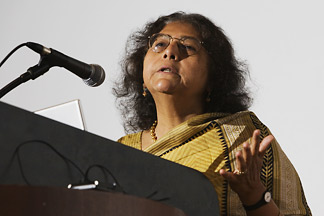
Sheila Jasanoff, professor of science and technology studies at Harvard University and founding chair of Cornell's science and technology studies department, delivers a plenary lecture, "Constituting the Nanoscale: Lessons from the 20th Century," at the CNF 30th anniversary celebration June 14. |
Abstract:
The Cornell campus buzzed with close to 380 participants at the 30th anniversary celebration of the Cornell NanoScale Science and Technology Facility (CNF), June 14. Topics addressed included drug delivery, ethics and even science fiction.
CNF reflects on past, looks to future of nanoscience at 30th anniversary celebration
ITHACA, NY | Posted on June 18th, 2007Scientists from all over the country and world, including many from Cornell, gathered to hear expert speakers, participate in technical sessions and attend a research poster presentation at day's end.
The anniversary symposium, "The Future of Nanotechnology," kicked off with reflections from Edward Wolf, professor emeritus of electrical and engineering and CNF director from 1978 to 1988. He recounted that in the early years, CNF was called the National Research and Resource Facility for Submicron Structures. "Nano" was not part of the title until 1987, when the facility was renamed the National Nanofabrication Facility. In 2003 CNF took on its present name.
Despite these iterations, CNF has long been connected closely with the National Science Foundation (NSF), which has provided the majority of CNF funding during its entire existence.
Lawrence Goldberg, senior engineering adviser of NSF's Division of Electrical and Communications Systems, called CNF a "vibrant enterprise" that has surpassed its founding concept and evolved into a world leader in nanoscience and nanofabrication.
"The National Science Foundation is very proud to have played a continuing role in that success," said Goldberg, who oversees the National Nanotechnology Infrastructure Network, a 13-member consortium, including Cornell, of nanoscience-focused institutions.
The day's themes were laid out by three additional speakers. R. Stanley Williams, a senior fellow at Hewlett-Packard Laboratories, described the advances he and others at his company have made in nano-imprint lithography.
The technique, which is a progression from the more traditional method of photolithography for creating nanoscale devices, involves creating a mold of a device to stamp -- not unlike a rubber stamp -- an imprint of the device as a way of copying it.
Introducing the topic of nanomedicine, Tejal Desai, director of the University of California-San Francisco's Laboratory of Therapeutic Micro and Nanotechnology, spoke about therapeutics and drug delivery using nanotechnology. Nanomedicine, she said, continues to face the challenge of developing drugs or therapies that can be taken orally and are able to withstand the physiology of the digestive system.
The third plenary speaker, Sheila Jasanoff, professor of science and technology studies at Harvard University who also was founding chair of Cornell's department of the same name, spoke on the politics and societal implications of nanotechnology.
While drawing comparisons between public perceptions of nanotechnology and the Manhattan Project or genetically modified foods, she also noted that built into the early stages of nanotechnology research is a widespread desire to take social and ethical considerations seriously.
She urged the use of "technologies of humility," and to proceed with nanoscience breakthroughs "grounded in memory and experience."
Following the plenary speakers, the participants spent the afternoon in tracks dedicated to each of the three topics.
Phaedon Avouris, manager of Nanometer Scale Science and Technology at IBM's T.J. Watson Research Center, addressed present and future promise of carbon nanotubes in terms of electronics and optoelectronics.
Michael Sheetz, chair of Columbia University's Nanotechnology Center for Mechanics and Regenerative Medicine, discussed cellular mechanics through nanotechnology. And Rosalyn Berne, associate professor of science, technology and society at the University of Virginia, in discussing the social and ethnical dimensions of nanotechnology, suggested science fiction as a portal to ethics in nanotechnology.
####
About Cornell Univeristy
The strategic plan for research at Cornell can be summed up simply: Be the best at what we undertake to do. The research enterprise supports university research priorities: the New Life Sciences; cross-college collaborations; and enabling research areas--computing and information sciences, genomics, advanced materials, and nanoscience. We build on our strengths when creating programs, recruiting faculty, purchasing equipment, and supporting interdisciplinary programs. Cornell research is committed to knowledge transfer and engages in technology transfer and economic development activities that benefit local, regional, national, and international constituents.
For more information, please click here
Contacts:
Anne Ju
(607) 255-9735
Media Contact:
Blaine Friedlander
(607) 254-8093
Copyright © Cornell Univeristy
If you have a comment, please Contact us.Issuers of news releases, not 7th Wave, Inc. or Nanotechnology Now, are solely responsible for the accuracy of the content.
Bookmark:


| Related News Press |
Ethics
 Artificial Intelligence Centered Cancer Nanomedicine: Diagnostics, Therapeutics and Bioethics June 3rd, 2022
Iran to hold intl. school on application of nanomaterials in medicine September 20th, 2016
Synthetic biology needs robust safety mechanisms before real world application: Ethics and technology hold the key to the success of synthetic biology September 17th, 2015
March 2016; 6th Int'l Conference on Nanostructures in Iran July 29th, 2015
Announcements
NRL charters Navy’s quantum inertial navigation path to reduce drift April 5th, 2024
Discovery points path to flash-like memory for storing qubits: Rice find could hasten development of nonvolatile quantum memory April 5th, 2024
Interviews/Book Reviews/Essays/Reports/Podcasts/Journals/White papers/Posters
Simulating magnetization in a Heisenberg quantum spin chain April 5th, 2024
Discovery points path to flash-like memory for storing qubits: Rice find could hasten development of nonvolatile quantum memory April 5th, 2024
Events/Classes
Researchers demonstrate co-propagation of quantum and classical signals: Study shows that quantum encryption can be implemented in existing fiber networks January 20th, 2023
 |
||
 |
||
| The latest news from around the world, FREE | ||
 |
||
|
|
||
| Premium Products | ||
 |
||
|
Only the news you want to read!
Learn More |
||
 |
||
|
Full-service, expert consulting
Learn More |
||
|
|
||