Home > Press > New NanoIndenter™ Module for the AFM
New NanoIndenter™ Module for the MFP-3D™ Atomic Force Microscope
Santa Barbara, CA | Posted on July 18, 2006
Asylum Research, a leading manufacturer of atomic force microscopes (AFMs), announces the availability of the new NanoIndenter module for use with the Asylum Research MFP-3D AFM System.
The NanoIndenter is the first commercially available product to bridge the gap between conventional
nanoindenters and AFMs. Unlike cantilever-based nanoindenters (AFMs), the NanoIndenter drives the
nanoindenting tip perpendicular to the sample. And unlike conventional nanoindenters, tip displacement and force are measured with the MFP-3D AFM’s optical detector and the patent-pending NPS™ Nanopositioning sensors. This combination results in exquisite force and positioning sensitivity. This allows repeatable imaging, quantitative feature measurement, reliable and accurate imaging offsets, quantitative force curves, and incredibly precise positioning for manipulation and lithography.
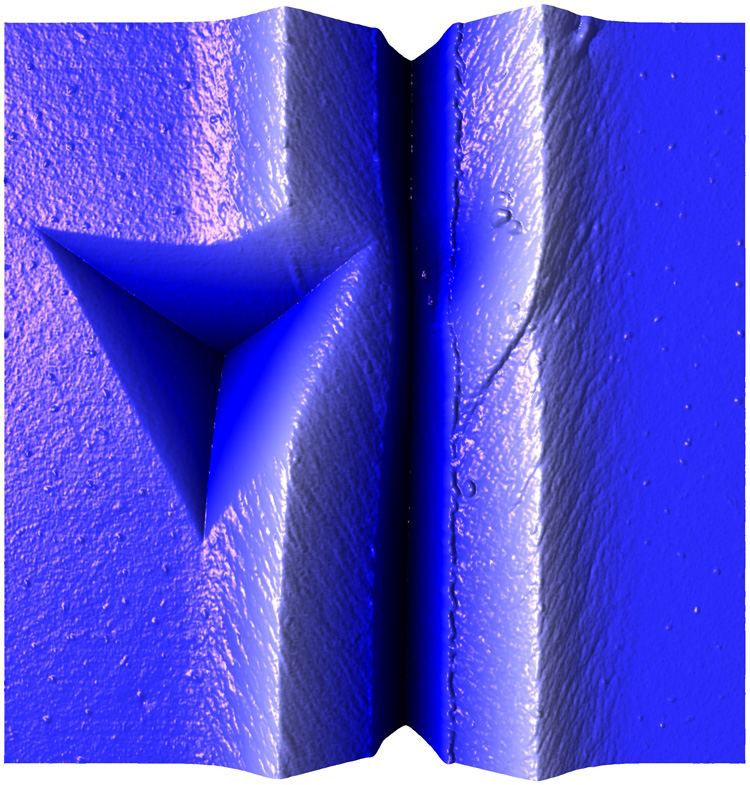
Indentation and scratch on polyurethane film, 17µm scan.
|
“Because the NanoIndenter is truly integrated with the premier metrology AFM, the MFP-3D, the user can measure forces and displacements with near AFM precision while avoiding the non-orthogonality issues that plague cantilever-based indentation measurements. This integration means that users can easily image the indenter tip itself and characterize its shape,” said Flavio Bonilla, Product Manager for the NanoIndenter.
“The software scripting ability native to the MFP-3D environment also makes this product ideal for scientists
automating measurements or working on new ways of characterizing materials.”
The NanoIndenter easily fits on the MFP-3D AFM head for easy viewing of the sample. It is available in two models, Standard and Low Force. The module comes with three standard sample mounts, small, medium and large.
Measurements and surface characterization can be done on many different materials including thin films,
coatings, polymers, etc. The NanoIndenter is ideal for a variety of applications including the elastic and inelastic behavior of materials; dislocation phenomena; fractures in ceramics; mechanical behavior of metals, thin films, ceramics, bone, biomaterials, residual stresses; and time dependent mechanical characteristics in soft metals and polymers.
MFP-3D, NanoIndenter, and NPS are trademarks of Asylum Research.
About Asylum Research:
Asylum Research manufactures advanced scientific instrumentation, including AFMs/Scanning Probe
Microscopes (SPMs), for nanoscale science and technology. An AFM/SPM is used for visualizing surfaces
and measuring surface properties at the nanometer level.
For more information, please click here.
Contact:
Terry Mehr
Director of Marketing
Asylum Research
6310 Hollister Ave., Santa Barbara, CA 93117
805-696-6466
terry@AsylumResearch.com
Copyright © Asylum Research
If you have a comment, please Contact us.
Issuers of news releases, not 7th Wave, Inc. or Nanotechnology Now, are solely responsible for the accuracy of the content.
Bookmark:


| Related News Press |
Announcements
 NRL charters Navy’s quantum inertial navigation path to reduce drift April 5th, 2024
Discovery points path to flash-like memory for storing qubits: Rice find could hasten development of nonvolatile quantum memory April 5th, 2024
Tools
Ferroelectrically modulate the Fermi level of graphene oxide to enhance SERS response November 3rd, 2023
The USTC realizes In situ electron paramagnetic resonance spectroscopy using single nanodiamond sensors November 3rd, 2023
 |
||
 |
||
| The latest news from around the world, FREE | ||
 |
||
|
|
||
| Premium Products | ||
 |
||
|
Only the news you want to read!
Learn More |
||
 |
||
|
Full-service, expert consulting
Learn More |
||
|
|
||