Home > Press > QBI Life Sciences uses Nanotechnology to advance Drug Discovery
QBI Life Sciences uses Nanotechnology to advance Drug Discovery
Madison, WI | August 10, 2005
Long interested in advancing the process of discovering new treatments for human diseases, the principals of QBI Life Sciences today announced the release of a second polymeric micelle product, PreserveX™-QML-B Polymeric Micelles. PreserveX™ Polymeric Micelles, useful in working with difficult to handle proteins average 21 nanometers in diameter. In the presence of native cell membrane fractions, PreserveX™ Polymeric Micelles self-assemble embedding pieces of cellular membranes in the complex creating multiple particles each providing an environment similar to that of the native membrane. Below is an illustration of this process.
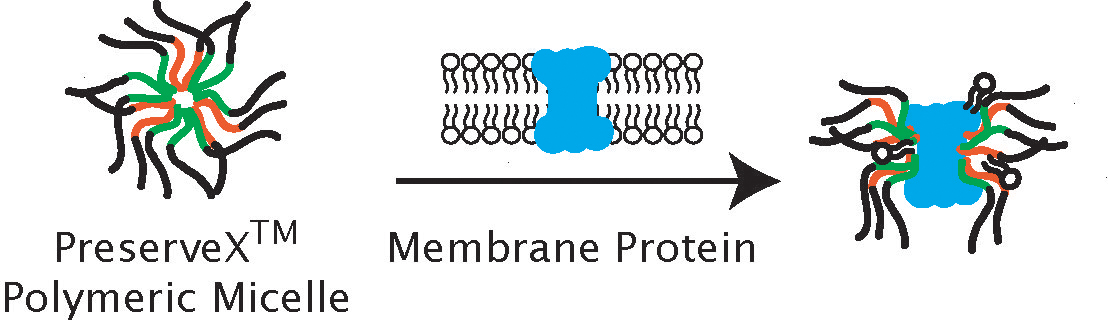
This graphic illustrates the use of PreserveX™ Polymeric Micelles to solubilize membrane proteins and associated lipids from membrane fractions resulting in stabilized micelle/protein/lipid complexes.
Copyright © QBI Life Sciences
|
The newly released product, PreserveX™-QML-B Polymeric Micelles contains a biotin label enabling the placement of the micelle/protein/lipid complex onto a solid support such as a protein microarray. Below is an illustration of complexes immobilized on a solid support.
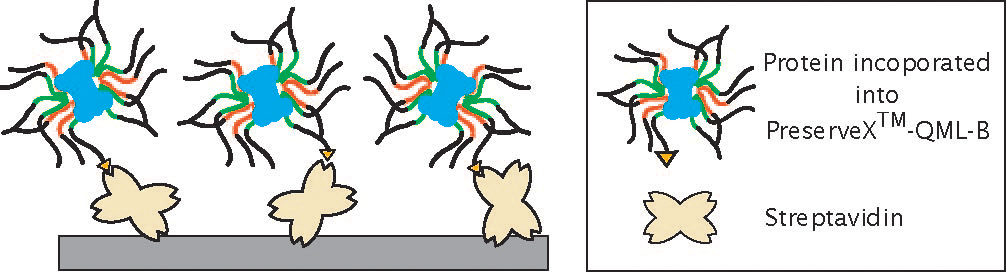
This graphic illustrates the use of PreserveX™-QML-B to immobilize the biotin-labeled micelle/protein/lipid complexes on a surface (bar at the bottom of the graphic) with the use of streptavidin. Once immobilized, ligand binding or enzymatic activity can be determined, or the presence of the protein can be confirmed.
Copyright © QBI Life Sciences
|
PreserveX™ Polymeric Micelles reflect the combination of polymer chemistry technologies with protein chemistry technologies. Vladimir Trubetskoy, Ph.D., Director of Polymer Chemistry has headed up a team at QBI Life Sciences to develop polymer nano-particles that are useful in working with some of the most difficult to handle proteins. Focusing on membrane proteins (those proteins that reside on, near or embedded in cellular membranes), Dr. Trubetskoy and his team of scientists have come up with a set of very valuable drug discovery tools. In the area of human health, membrane proteins represent 70% of all known drug targets, the agents inside the human body upon which drugs evoke a therapeutic effect. To date, efforts to study these proteins and develop drugs targeting these proteins have been limited.
Announcement of the introduction of PreserveX™-QML-B is coincident with a presentation of product performance at the 2005 Drug Discovery Technology® & Development World Congress in Boston, Massachusetts (link).
About QBI Life Sciences:
QBI Life Sciences is a division of Quintessence Biosciences, Inc. QBI Life Sciences is focused on development and supply of research tools focused on work with membrane proteins. The aim of the Company’s product development efforts is to enable new areas of research.
For more information, please visit www.qbilifesci.com
Media Contact:Ralph Kauten
(608) 441-2950
RalphK@qbilifesci.com
Copyright © QBI Life Sciences
If you have a comment, please Contact us.
Issuers of news releases, not 7th Wave, Inc. or Nanotechnology Now, are solely responsible for the accuracy of the content.
Bookmark:


| Related News Press |
Self Assembly
 Liquid crystal templated chiral nanomaterials October 14th, 2022
Nanoclusters self-organize into centimeter-scale hierarchical assemblies April 22nd, 2022
Atom by atom: building precise smaller nanoparticles with templates March 4th, 2022
Nanostructures get complex with electron equivalents: Nanoparticles of two different sizes break away from symmetrical designs January 14th, 2022
Nanomedicine
New micromaterial releases nanoparticles that selectively destroy cancer cells April 5th, 2024
Good as gold - improving infectious disease testing with gold nanoparticles April 5th, 2024
Researchers develop artificial building blocks of life March 8th, 2024
Announcements
NRL charters Navy’s quantum inertial navigation path to reduce drift April 5th, 2024
Discovery points path to flash-like memory for storing qubits: Rice find could hasten development of nonvolatile quantum memory April 5th, 2024
 |
||
 |
||
| The latest news from around the world, FREE | ||
 |
||
|
|
||
| Premium Products | ||
 |
||
|
Only the news you want to read!
Learn More |
||
 |
||
|
Full-service, expert consulting
Learn More |
||
|
|
||