Home > Nanotechnology Columns > Brian Wang > Finally proof of concept experiments funded for molecular nanotechnology
 |
Brian Wang Z1 Consulting |
Abstract:
Finally experiments have been funded to test the viability of diamond mechanosynthesis as described in detail by Robert Freitas and Ralph Merkle. This is a major step towards achieving the long held vision of molecular nanotechnology as envisioned by Eric Drexler. $3 million in funding has been made in the UK to Philip Moriarty.
August 11th, 2008
Finally proof of concept experiments funded for molecular nanotechnology
Finally experiments have been funded to test the viability of diamond mechanosynthesis as described in detail by Robert Freitas and Ralph Merkle. This is a major step towards achieving the long held vision of molecular nanotechnology as envisioned by
http://www.e-drexler.com/
Eric Drexler
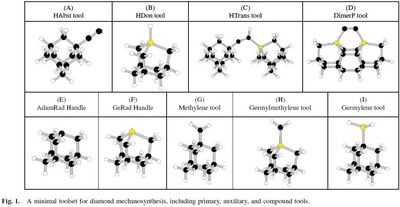 |
| Freitas-Merkle minimal molecular toolset |
http://nextbigfuture.com/2007/04/robert-freitas-interview-at-lifeboatcom.html
Based on an interview of Robert Freitas in 2007.
Based on the computational chemistry work, their latest estimates suggest that an ideal research effort paced to make optimum use of available computational, experimental, and human resources would probably run at a $1-5M/yr level for the first 5 years of the program, ramp up to $20-50M/yr for the next 6 years, then finish off at a ~$100M/yr rate culminating in a simple working desktop nanofactory appliance in year 16 of a ~$900M effort.
Nanofactory images
Robert Freitas believes that early nanofactories necessarily will be extremely primitive. They will be very limited in the composition and complexity of products they can build and in the types of chemical elements and feedstocks they can handle. They will be fairly unreliable and will require significant supervision and maintenance. They will be relatively expensive to own and operate. Over a period of perhaps 10-20 years, nanofactory costs and capabilities will slowly improve and product costs will gradually drift downward toward the likely $1/kg regulatory floor, giving society some time to adjust to new threats as nanofactories become increasingly ubiquitous in our environment and economy.
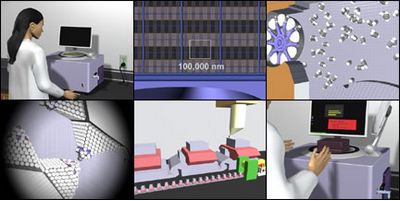
The experimental proof of the nine molecular tools are the first funded steps on a journey of 27 years. [Unless after the first few years, funding is substantially increased and the effort is more coordinated then competing Manhattan projects could achieve results in half the time.]
Products of More Mature Molecular Nanotechnology
MNT-built diamond products can be at least ten times stronger than steel, 100 times stronger than aluminum or plastic.
-desktop computers with a billion processors
-inexpensive, efficient solar energy systems
-medical devices able to destroy pathogens and repair tissues
-materials 100 times stronger than steel
-superior military systems
-exponential manufacturing [I build one factory, it builds two factories, they build four factories and so on and so on]
-additional molecular manufacturing systems
http://en.wikipedia.org/wiki/Molecular_nanotechnology
More from the wikipedia entry
http://en.wikipedia.org/wiki/Molecular_nanotechnology#Smart_materials_and_nanosensors" target=blank>smart materials and nanosensors
http://en.wikipedia.org/wiki/Molecular_nanotechnology#Medical_nanorobots
medical nanorobots and
http://en.wikipedia.org/wiki/Nanomedicine
nanomedicine
-
http://en.wikipedia.org/wiki/Molecular_nanotechnology#Utility_fog
Utility fog
-
http://en.wikipedia.org/wiki/Molecular_nanotechnology#Phased-array_optics
Phased array optics
http://www.molecularassembler.com/Nanofactory/Media/PressReleaseAug08.htm
Professor Philip Moriarty of the Nanoscience Group in the School of Physics at the University of Nottingham (U.K.) has been awarded a five-year £1.53M ($3.1M) grant by the U.K. Engineering and Physical Sciences Research Council (EPSRC) to perform a series of laboratory experiments designed to investigate the possibility of diamond mechanosynthesis (DMS).
DMS is a proposed method for building diamond nanostructures, atom by atom, using the techniques of scanning probe microscopy under ultra-high vacuum conditions. Moriarty's project, titled "Digital Matter? Towards Mechanised Mechanosynthesis," was funded under the Leadership Fellowship program of EPSRC. Moriarty's experiments begin in October 2008.
http://gow.epsrc.ac.uk/ViewGrant.aspx?GrantRef=EP/G007837/1
The five year grant is described here
Computer-controlled chemistry at the single molecule level, a field very much in its infancy, represents arguably the most exciting and, to many, definitive example of the power and potential of nanotechnology. Recent ground-breaking work in Germany and the US has shown that it is possible to drive chemical reactions and to synthesise molecules via interactions driven by a scanning probe. In the UK, the nanoscience groups at Nottingham, Birmingham, and Oxford have demonstrated that atomic/molecular manipulation strategies pioneered at low temperatures can be extended to a room temperature environment. The focus of this fellowship application is to develop next-generation protocols for scanning probe manipulation capable of automated atom-by-atom assembly of, ultimately, three dimensional nanostructures. Our goal is to program the assembly of matter from its constituent atoms. This exceptionally challenging objective has the potential to revolutionize key areas of 21st century science including nanofabrication, materials processing, surface chemistry, and the study of low dimensional electron systems.
Moriarty is interested in testing the viability of positionally-controlled atom-by-atom fabrication of diamondoid materials as described in the Robert Freitas-Ralph Merkle
http://www.MolecularAssembler.com/Papers/MinToolset.pdf
minimal toolset theory paper.
Moriarty's efforts will be the first time that specific predictions of DFT in the area of mechanosynthesis will be rigorously tested by experiment. His work also directly addresses the requirement for "proof of principle" mechanosynthesis experiments requested in the 2006 National Nanotechnology Initiative (NNI) review, in the 2007 Battelle/Foresight nanotechnology roadmap, and by EPSRC's Strategic Advisor for Nanotechnology, Richard Jones (Physics, Sheffield University, U.K.).
"We congratulate Philip for his tremendous success in securing funding for this pathbreaking effort," said Freitas. "We look forward to working together closely with his experimental team as this exciting project goes forward over the next five years."
FURTHER READING
http://www.nottingham.ac.uk/physics/about/staffbyrole.php?id=NTM5NzI4&page_var=personal
Philip Moriarty
http://www.nottingham.ac.uk/physics/research/nano/
Nanoscience group
http://www.nottingham.ac.uk/physics/
School of Physics at the University of Nottingham
http://www.epsrc.ac.uk/
U.K. Engineering and Physical Sciences Research Council (EPSRC)
http://www.epsrc.ac.uk/ResearchFunding/Opportunities/Fellowships/LF.htm
Leadership Fellowship program
http://www.rfreitas.com
Robert Freitas' site
http://www.imm.org
Institute for Molecular Manufacturing
http://www.softmachines.org/wordpress/?p=70
Mechanosynthesis debate
http://www.merkle.com
Ralph Merkle's site
http://www.MolecularAssembler.com/Nanofactory
The nanofactory vision is described here
http://www.MolecularAssembler.com/Nanofactory/Publications.htm
Nanofactory publications
http://www.MolecularAssembler.com/Papers/JNNDimerTool.pdf
Dimer tool paper 2003
http://www.MolecularAssembler.com/Papers/JCTNPengMar04.pdf
Theoretical Analysis of Diamond Mechanosynthesis. Part I. Stability of
C2 Mediated Growth of Nanocrystalline Diamond C(110) Surface 2004
http://www.MolecularAssembler.com/Papers/JCTNPengFeb06.pdf
Theoretical Analysis of Diamond Mechanosynthesis. Part III. Positional C2 Deposition on Diamond C(110) Surface Using Si/Ge/Sn-Based Dimer Placement Tools
http://www.MolecularAssembler.com/Papers/TemelsoHAbst.pdf
High-level Ab Initio Studies of Hydrogen Abstraction from Prototype Hydrocarbon Systems
http://www.MolecularAssembler.com/Papers/DPTMotifs.pdf
Horizontal Ge-Substituted Polymantane-Based C2 Dimer Placement TooltipMotifs for Diamond Mechanosynthesis
http://www.MolecularAssembler.com/Papers/TemelsoHDon.pdf
Ab Initio Thermochemistry of the Hydrogenation of Hydrocarbon Radicals Using Silicon-,
Germanium-, Tin-, and Lead-Substituted Methane and Isobutane
http://www.foresight.org/roadmaps/index.html
Atomically precise manufacturing roadmap
Bookmark:


 |
||
 |
||
| The latest news from around the world, FREE | ||
 |
||
|
|
||
| Premium Products | ||
 |
||
|
Only the news you want to read!
Learn More |
||
 |
||
|
Full-service, expert consulting
Learn More |
||
|
|
||